Fr
Fr  Eng
Eng  Sp
Sp  Укр
Укр 

Amphores
Wine lovers have probably encountered amphora wines in their tasting practice. This is the name given to wines that have been made in a clay container at some stage (either during fermentation or during ageing, or both). The word «amphora» is used as an international unification for such a vessel, although the names and their appearances differ from country to country. An amphora is a vase-shaped clay container. Clay jars are considered the earliest wine containers in human history. In Georgia, in the «cradle of winemaking», amphoras are found under the name «qvevri» (Georgian ქვევრი). They have always been used, and in different regions of the country they differ slightly in appearance. For example, in warmer regions of Georgia, kvevri have a more elongated shape, as they are buried deeper in the ground. Georgian kvevri was used as early as 7000 BC. J.-C.

Historian Levan Pruidze believes that the Georgians started making wine vessels as soon as they learned to work with clay, that is, during the Neolithic era. And although it is very difficult to establish the exact time of origin of the first kvevri, it is known that historically in Georgia, as today, there were two main centers of construction of kvevri — in the west , in Imereti and in the east — in Kakheti. Making a kvevri is a construction, it is built layer by layer, taking your time, letting the previous layer dry well, and taking care not to disturb the proportions. The craftsman who builds a kvevri is called mekvevre in Georgian. In Georgia there is no school that teaches how to build a kvevri, as a rule, knowledge is passed from generation to generation. Levan Pruidze, however, believes that knowledge and experience are not enough — for kvevri to come out, the master must have mystical intuition. «The mystery lies in the fact that Mekvevre can only intuitively determine the proportions and ensure that they are not disturbed during the construction process», explains the historian.

Not all clays are suitable for kvevri. There is a certain type of particularly resistant clay, which is extracted in quarries designed solely for this purpose. Kvevri from another clay can quickly crack. Kvevri are built in a special, draft-free room, where the same temperature is constantly maintained. The type of clay is also extremely important for winemaking, as the quality of wine depends on the quality of the raw materials from which the kvevri is made. The clay also includes lime, a natural antiseptic.

In the premises where the kvevri are built, it is forbidden to speak aloud, as well as to smoke. The Kvevri like silence, because they have a certain energy. They must be protected from contamination, so that later the wine, which is also a living organism, does not take over the negative energy.
Firing is an equally complicated process: the fire in the oven must burn for three days and three nights, and that’s not a saying from folk tales. The burnt kvevri gradually changes color from gray to orange and here the craftsman must again trust his intuition to determine that the container is ready. Only hornbeam or beech wood is suitable for firing kvevri. From the inside, the new kvevri is covered with a layer of special wax. Outside, the burnt kvevri is covered with a layer of cement that will protect it from underground destruction.

In Spain, an earthenware vessel for wine is called «tinaja», and it looks more like an egg. In Portugal, the container is called «talha», in Armenia — «karas». But in Italy, the vases are called amphorae. You can also find the word jar there. Their shape has proven its effectiveness even today, as it can provide ideal conditions for the maturation of wine without the intervention of the winemaker. An interesting fact is that to this day all amphoras are made by hand.

Amphoras were mentioned in the wake of the reconstruction of historical winemaking methods and the search for alternative, as natural as possible methods of vinification and aging, when natural wines and orange wines (wines whites in the skin method — contact of the grape must with the skin during vinification) became fashionable. Today, wines in amphoras are made not only in Georgia, but also in France, Chile, Italy and other countries.

Indeed, it took two millennia for the amphoras to return to the cellars again. In search of particular flavors, clay containers are used today in winemaking, as well as oak barrels, stainless steel tanks and tuns. Amphoras with a volume of 200 to 3000 liters are most often used for commercial wines. Caring for an amphora is easy, which is much more convenient than an oak barrel. The main disadvantage of this type of container is its fragility.

Amphoras, like barrels, allow wine to breathe through the process of micro-oxygenation. Clay is a very neutral material that does not alter the taste of wine. Chemistry therefore does its work of aeration (binds tannins and anthocyanins) to reveal more roundness and fruitiness during ageing. Slow stirring in an amphora optimizes yeast autolysis for a silkier mouthfeel while preserving the purity of the fruit.

For red wines, the objective is gentle aging to give complexity to the tannins and aromatic finesse. One of the biggest advantages of amphoras is the extremely natural vinification without any «violence». The wine is macerated, infused and extracted gently, long and slowly, which gives incomparably silky tannins even on very tannic varieties such as Mourvèdre or Malbec. Another advantage of wine in amphora is that vinification can take place simultaneously with ageing.
For the production of wine according to traditional Kakheti technology, kvevri are buried up to their necks in the ground in special warehouses marani (translated from Georgian — «wine cellar», a kind of analogue of the European terms estate, castle, castello or tenuta) and stay there permanently. The kvevri is buried in dry soil with good drainage.

Harvested grapes (harvest in Georgian — rtveli) are pressed in special satsnakhel presses and poured into kvevri up to the neck with pulp, grape seeds and stalks, where fermentation and aging follow one another. This Georgian technology belongs to the UNESCO cultural heritage list. During the fermentation process, the skin, grape seeds and stalks rise up and form a dense «cap». Sometimes it is broken up and again mixed with must. The ovoid shape of the kvevri favors the natural circulation of the must. Wine matures in kvevri at a constant, natural earth temperature of 14-15 degrees. At this temperature, the extraction of the active substances is very slow.

In Georgia (or in other regions that use the same methods but without burying the amphoras) this makes it possible to produce macerated white wines called «orange wine». Red and white wines are vinified according to the same scheme. The contact of the skin with the juice allows a phenolic extraction which stabilizes the wines, without recourse to SO2 which favors the purity of the grape juice. Once the alcoholic fermentation process is complete, malolactic fermentation can begin naturally.

After the end of fermentation, the skins, lees and seeds fall to the bottom. Currently the kvevri are covered with wooden lids and sealed with clay to protect the wine from the air. A large stone is sometimes placed on the lid. In this form, the wine is left until the end of winter.
Maturation lasts about six months. Depending on the cuvées and vintages, this period can last up to a year. During aging in kvevri, the wine naturally brightens, becomes crystalline (white or red) and does not need additional filtration, as the remaining skin is not pressed.

In the spring (often at Easter), the wine matured on the musts is carefully transferred to another kvevri, from 50 to 300 liters, previously cleaned with spruce bushes and stored until consumption. In these kvevri, wine is aged with little access to oxygen. After a few months, the wine is bottled.

With the necessary maintenance, the amphoras can serve for about thirty years. For this, they must be washed regularly. Between each wine, it is necessary to carry out disinfection by pouring citric or tartaric acid. When the amphora is empty, it is best to leave it open to ensure good ventilation. The maintenance of an amphora is easy, which is much more practical than an oak barrel.
Winegrowers choose amphoras to create wines with a pronounced fruity profile. But sometimes, in search of new tastes and aromas, some winegrowers add alternative oak products to the amphora, to enrich the wine with notes of aging. Just like grape seeds and stalks, the pieces of oak remain in the amphora throughout the vinification/aging period. As a rule, oak chips are not used for aging in amphoras, but the staves or cubes.

The dosage varies from 1 to 5 g/l depending on the desired woody intensity and the character of the wine. Toasted pieces of oak wood can be added to red wines as well as white wines during vinification in amphoras. When using cubes, it is more convenient to place them in a filter mesh.

The winemaker chooses the level of toasting of alternative products according to the style of the wine. It is possible to mix wood of different toasting levels, knowing that the more the wood is toasted, the less it will improve the structure of the wine, and the more it will affect the aroma.
The influence of alternative oak products on the aromatic profile of the wine depends on the level of toasting of oak wood. There are 4 main levels of wood toasting for oenology:
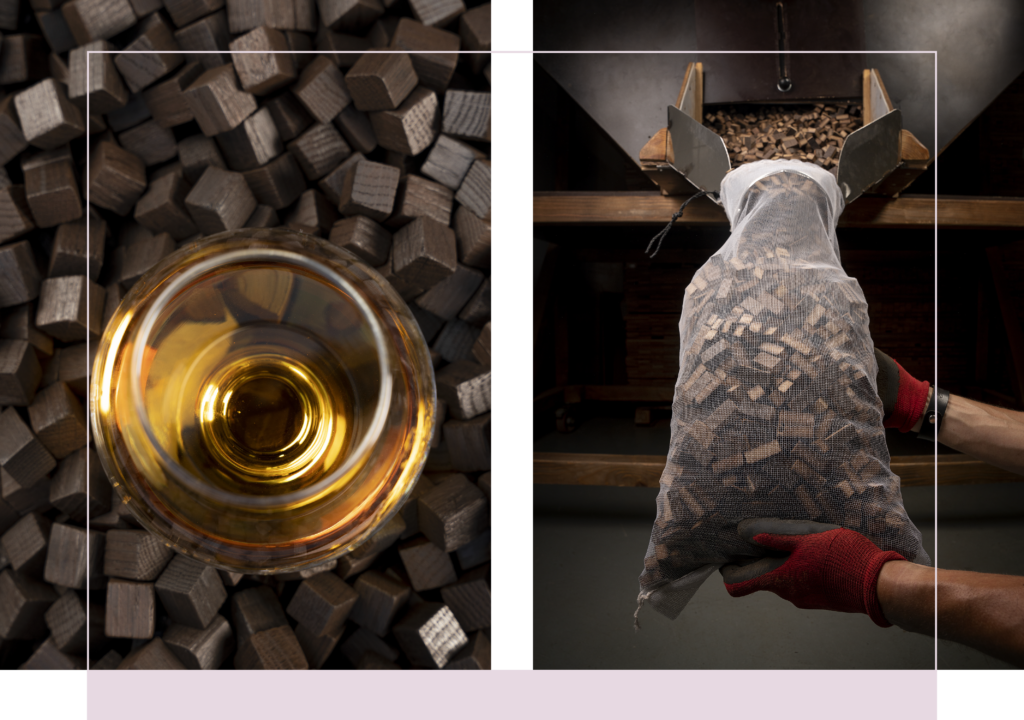
• untoasted wood — above all, it allows maximum development of fruity notes, reduces herbaceous and reductive aromas, stabilizes the color of red wines, increases the sugar content, strengthens the structure and aging potential of the wine;
• light toast — suitable for wines which require minimal aroma enhancement and higher tannin content. The Light Toast provides a delicate vanilla note and allows the fruity aroma of the wine to develop;
• medium toast — ideal for concentrated red and white wines and mature white wines. This toast imparts signicantly greater complex and toasty aromas; the longer toasting period provides the greater lignin degradation, producing a stronger vanilla aroma;
• heavy toast — ensures almost complete decomposition of the chemical components present in the oak. This level of toast is ideal for wines looking for full impact of complex aromas and flavor notes with a lesser contribution of tannins to the wine structure. The Heavy toast gives a smoky and black pepper taste and aroma to the wine.